education
Square Footage Calculator: The Complete Guide to Calculating Square Feet

Published
2 months agoon
Table of Contents
ToggleA square footage calculator is a simple and useful tool that helps you determine the area of a room, house, office, floor, property, or other space. Knowing the square footage of an area is important for many everyday tasks, including buying flooring, estimating paint requirements, planning furniture layouts, calculating construction materials, comparing property sizes, and understanding the total usable space of a building. While calculating square footage may sound complicated, the basic process is usually very easy when you know the length and width of the area. By entering the correct measurements into a square footage calculator, you can quickly find the total area in square feet without performing complicated mathematical calculations.
The basic formula for calculating the square footage of a rectangular or square area is length × width = square feet. For example, if a room is 12 feet long and 10 feet wide, you can multiply 12 by 10 to get 120 square feet. However, many real-world spaces are not perfect rectangles. Rooms may have unusual corners, extensions, hallways, alcoves, or other irregular shapes. In these situations, the best method is to divide the space into smaller rectangular or square sections, calculate the square footage of each section separately, and then add the results together. This complete guide explains how a square footage calculator works, how to measure different types of spaces, how to calculate irregular areas, how to convert measurements, and how to avoid common mistakes when calculating square feet.
What Is a Square Footage Calculator?
A square footage calculator is a measurement tool designed to calculate the area of a space in square feet. Square footage, commonly written as sq. ft. or ft², represents the amount of two-dimensional surface area contained within a space. It is commonly used for rooms, apartments, houses, offices, warehouses, garages, gardens, patios, floors, and land areas. Instead of manually multiplying measurements every time, a calculator allows you to enter the dimensions of an area and quickly receive the total square footage.
The most common calculation involves a rectangular space. If you know the length and width in feet, you simply multiply those two measurements. For example, a bedroom that is 15 feet long and 12 feet wide has an area of 180 square feet because 15 × 12 = 180. A square footage calculator can perform this calculation instantly and can also be useful when working with multiple sections or different measurement units. Some calculators allow users to enter several rooms or areas and combine them to find the total square footage of an entire house or property.
How to Calculate Square Footage
The simplest way to calculate square footage is to use the following formula:
Length × Width = Square Footage
Both measurements should ideally be in feet. For example, if your living room measures 20 feet in length and 14 feet in width, multiply the two numbers together:
20 × 14 = 280 square feet
Therefore, the living room has a total area of 280 square feet. This basic formula works for most rectangular and square rooms. Before taking measurements, measure the longest side of the room for the length and the other side for the width. It is important to measure accurately, especially when you are purchasing expensive materials such as hardwood flooring, tiles, carpet, concrete, or other construction supplies.
When measuring a room, you should generally measure from wall to wall rather than estimating the dimensions. If the walls are not perfectly straight or the room has unusual features, take multiple measurements and divide the space into smaller sections. A small measurement error can make a significant difference when calculating the total square footage of a large building or property.
Square Footage Calculator Formula
The square footage formula is straightforward:
Square Feet = Length × Width
For example:
- Length: 18 feet
- Width: 12 feet
- Calculation: 18 × 12
- Total area: 216 square feet
If you are measuring a larger property with several rooms, calculate each room individually and then add the results. For example, suppose a home has a living room measuring 300 square feet, a kitchen measuring 150 square feet, three bedrooms measuring 120 square feet each, and a hallway measuring 60 square feet. The total calculated area would be the sum of all these individual spaces. This method is often more accurate than trying to measure the entire home as one large shape, especially when the building has multiple sections or an unusual layout.
How to Calculate the Square Footage of a Room
Calculating the square footage of a room is one of the most common reasons people use a square footage calculator. Begin by measuring the length of the room in feet. Then measure the width of the room in feet. Once you have both measurements, multiply them together. For example, a room measuring 16 feet by 11 feet has an area of 176 square feet.
If the room includes a closet, alcove, or additional section, you can decide whether that area should be calculated separately. For the most accurate result, measure each section individually. Calculate the square footage of the main room, then calculate the square footage of the additional space, and finally add the two totals together. This approach is especially useful when estimating flooring or carpet because the materials may need to cover the entire floor area.
How to Calculate the Square Footage of a House
To calculate the approximate square footage of a house, measure each floor and major area separately. For a simple one-story rectangular home, you may be able to multiply the total exterior length by the total exterior width. However, homes often have complex layouts, garages, extensions, porches, and irregular designs, so measuring individual sections can provide a more accurate result.
For a multi-room house, calculate the square footage of each room and add the results together. You may include bedrooms, living rooms, kitchens, bathrooms, hallways, offices, and other finished interior spaces depending on the purpose of your calculation. When calculating property size for official real estate, legal, appraisal, or construction purposes, it is important to understand that different standards may determine which spaces count toward the official square footage. A simple personal calculation may not always match the official measurement used by a professional surveyor, appraiser, or real estate organization.
How to Calculate Square Footage for an Irregular-Shaped Area
Not every space is a perfect rectangle. Some rooms have L-shaped designs, angled walls, curved sections, or multiple extensions. The easiest way to calculate the square footage of an irregular area is to divide it into smaller shapes that are easier to measure. Most irregular areas can be divided into rectangles, squares, triangles, or other basic geometric shapes.
For example, imagine an L-shaped room. You can divide it into two rectangular sections. Measure the length and width of the first section and calculate its area. Then measure the second section and calculate its area. Finally, add both results together. If the first section is 10 feet by 12 feet, it has 120 square feet. If the second section is 8 feet by 6 feet, it has 48 square feet. The total area would therefore be 168 square feet.
This method works because the total area of the irregular space is equal to the combined area of its smaller sections. When using a square footage calculator, you can calculate each section separately and then add the results manually or use a calculator that supports multiple areas.
How to Calculate Square Footage from Inches
Sometimes measurements are provided in inches instead of feet. In this situation, convert the measurements to feet before calculating the area. There are 12 inches in 1 foot. To convert inches to feet, divide the measurement by 12.
For example, if a room is 144 inches long and 120 inches wide, convert the measurements first:
- 144 ÷ 12 = 12 feet
- 120 ÷ 12 = 10 feet
Then multiply the converted measurements:
12 × 10 = 120 square feet
You can also calculate the area directly in square inches and then convert the final result to square feet, but converting each dimension to feet first is usually easier and less likely to cause mistakes.
Square Feet to Square Meters Conversion
Square footage is commonly used in the United States, while square meters are used in many other parts of the world. If you need to convert between square feet and square meters, remember that 1 square foot is approximately equal to 0.092903 square meters. To convert square feet to square meters, multiply the number of square feet by 0.092903.
For example, an area of 1,000 square feet is approximately 92.9 square meters. To convert square meters to square feet, multiply the number of square meters by approximately 10.764. These conversions are helpful when comparing property listings, reading architectural plans, ordering materials from international suppliers, or working with construction measurements that use different systems.
How to Calculate Square Footage for Flooring
A square footage calculator is particularly useful when buying flooring. First, measure the length and width of each area where flooring will be installed. Calculate the square footage of every room and then add the totals together. After calculating the total floor area, it is usually wise to purchase additional material to account for cutting, mistakes, damaged pieces, and future repairs.
The amount of extra material needed depends on the type of flooring and the complexity of the installation. A simple rectangular room may require less extra material than a room with many corners or unusual angles. When purchasing flooring, always check the manufacturer’s recommendations because packaging, installation patterns, and material type can affect how much additional flooring is needed.
How to Calculate Square Footage for Paint
Calculating floor area and calculating paint coverage are not exactly the same thing. A square footage calculator can help determine the size of a floor, but painting a room requires calculating the surface area of the walls and sometimes the ceiling. To estimate wall area, measure the perimeter of the room and multiply it by the wall height. You may then subtract the area of doors and windows if you want a more precise estimate.
For example, if the total wall length around a room is 60 feet and the walls are 8 feet high, the approximate wall surface area is 480 square feet before subtracting doors and windows. Paint coverage depends on the type of paint and the number of coats required, so always check the coverage information on the product label. A calculator can help you estimate the surface area, but the amount of paint required will depend on the paint’s coverage rate.
Common Mistakes When Calculating Square Footage
One of the most common mistakes is using incorrect units. If one measurement is in feet and the other is in inches, multiplying them directly will produce an incorrect result. Always convert measurements to the same unit before performing the calculation. Another common mistake is forgetting to measure every section of an irregular space. If a room includes an alcove, extension, or separate section, leaving that area out can lead to an inaccurate total.
Rounding measurements too early can also reduce accuracy. If your measurements include decimals, it is usually better to keep the decimal values during the calculation and round the final result. Additionally, people sometimes confuse perimeter with area. Perimeter measures the distance around an object, while square footage measures the total surface area inside the boundaries. These are different calculations and should not be used interchangeably.
Why Accurate Square Footage Matters
Accurate square footage is important for many financial and practical decisions. When purchasing flooring, tile, carpet, paint, concrete, or other materials, incorrect measurements can cause you to buy too much or too little. For property owners, square footage can help with planning renovations, comparing spaces, estimating costs, and organizing furniture. For contractors and construction professionals, accurate area calculations are essential for estimating materials and labor.
In real estate, square footage can also influence how properties are compared and valued. However, the way square footage is officially measured can vary depending on location, building standards, and the purpose of the measurement. If an exact official measurement is required for a legal, appraisal, or real estate purpose, professional measurement may be necessary.
Conclusion
A square footage calculator makes it easy to calculate the area of rooms, houses, offices, floors, patios, land, and other spaces. For a simple rectangular area, the basic formula is easy: multiply the length by the width to find the total square feet. When dealing with an irregular space, divide the area into smaller sections, calculate each section separately, and add the results together. By using accurate measurements and consistent units, you can quickly calculate square footage and make better decisions when planning construction, renovation, flooring, painting, landscaping, or property improvements.
Whether you are measuring a small bedroom or an entire building, understanding how to calculate square footage gives you a useful skill that can save time, reduce waste, and improve the accuracy of your project. A reliable square footage calculator can make the process even faster by handling the calculations for you, but knowing the basic formula helps you verify the results and understand exactly how the total area was determined.
Frequently Asked Questions About Square Footage Calculators
What is a square footage calculator?
A square footage calculator is a tool that calculates the area of a space in square feet. You typically enter the length and width of an area, and the calculator multiplies the measurements to determine the total square footage.
How do I calculate square footage?
To calculate square footage, multiply the length of an area by its width. The basic formula is Length × Width = Square Feet. Make sure both measurements use the same unit, preferably feet.
How do I calculate the square footage of a room?
Measure the room’s length and width in feet, then multiply those two measurements. For example, a room measuring 12 feet by 10 feet has 120 square feet.
How do I calculate the square footage of an L-shaped room?
Divide the L-shaped room into two or more rectangles. Calculate the square footage of each rectangle separately and add the results together to find the total area.
Can I calculate square footage using inches?
Yes. Convert inches to feet by dividing the measurement by 12 before using the square footage formula. Keeping all measurements in the same unit helps prevent calculation errors.
How many square feet are in a square meter?
One square meter is approximately equal to 10.764 square feet. One square foot is approximately equal to 0.092903 square meters.
How do I calculate the square footage of a house?
Measure and calculate the area of each room or section, then add all the individual square-footage totals together. For official property measurements, professional standards may apply.
How much extra material should I buy for flooring?
The amount of extra flooring depends on the material and the complexity of the room. Many projects require additional material for cutting and waste, so check the manufacturer’s recommendations before purchasing.
Is square footage the same as perimeter?
No. Square footage measures the area inside a space, while perimeter measures the distance around the outside edge of the space.
Why is accurate square footage important?
Accurate square footage helps you estimate materials, plan renovations, compare property sizes, calculate floor areas, and reduce the risk of buying too much or too little material.
You may like
education
Unit 1 Progress Check MCQ Part C Answers: Complete Guide and Explanations
Published
2 months agoon
July 29, 2026
Table of Contents
ToggleStudents often search for Unit 1 Progress Check MCQ Part C answers when they want to review their performance, check difficult questions, prepare for an upcoming assessment, or understand concepts they may have missed during class. However, the phrase “Unit 1 Progress Check” can refer to different subjects, courses, schools, and educational platforms. Because the questions and answer choices may vary, there is no single universal answer key that applies to every Unit 1 Progress Check Part C assessment. The most useful approach is to identify the course, review the concepts tested in the unit, analyze each multiple-choice question carefully, and understand the reasoning behind the correct option.
A strong review guide should do more than provide a letter such as A, B, C, or D. It should help students understand why one option is correct, why the other options may be incorrect, and how the same concept could appear in a different question. This article explains how to approach Unit 1 Progress Check MCQ Part C questions, how to review answers effectively, how to avoid common multiple-choice mistakes, and how to prepare for similar assessments. The goal is to turn answer checking into meaningful learning that can improve future performance.
What Is a Unit 1 Progress Check?
A Unit 1 Progress Check is generally an assessment designed to measure how well students understand the major ideas, vocabulary, skills, and learning objectives covered during the first unit of a course. Depending on the educational program, the assessment may include multiple-choice questions, short-response questions, data-analysis activities, source-based questions, or other forms of evaluation. The purpose is usually to identify areas of strength and reveal topics that need additional review before students move to more advanced material.
The meaning of MCQ Part C may differ from one course or platform to another. In some assessments, Part C may refer to a specific group of multiple-choice questions. In other cases, it may identify a section with a different level of difficulty, a particular skill, or a separate collection of questions. Students should therefore avoid assuming that an answer key found for another class will match their own assessment. Even when two courses use the same title, the questions may have different wording, answer choices, or versions.
Why There Is No Universal Unit 1 Progress Check MCQ Part C Answer Key
The keyword Unit 1 Progress Check MCQ Part C answers is broad because it does not identify the subject, course level, school, teacher, or assessment version. A progress check for mathematics may test equations, patterns, graphs, or numerical reasoning, while a progress check for science may focus on scientific methods, evidence, measurements, or foundational concepts. A history course may use primary sources, historical arguments, or chronological reasoning, and an English course may assess reading comprehension, vocabulary, grammar, or literary analysis.
For this reason, students should be careful when using online answer pages. A list of answer letters without the original questions may be inaccurate or misleading. For example, an answer listed as “B” is useful only if the question and answer choices are exactly the same. If the options are rearranged, the correct idea may still be present, but the letter could be different. Understanding the concept behind the answer is much more reliable than memorizing a sequence of letters.
How to Review Unit 1 Progress Check MCQ Part C Answers
The first step is to read the complete question carefully. Many multiple-choice mistakes happen because students focus on one familiar word and select an answer before understanding what the question is asking. Look for important terms such as best, most likely, primary, main, except, not, supported by, or most accurate. These words can change the meaning of the question and determine which answer is correct.
After reading the question, identify the main concept being tested. Ask yourself what topic from Unit 1 is connected to the question. This could be a definition, formula, rule, process, historical development, scientific principle, reading skill, or analytical method. Once the concept is clear, compare every answer choice with the information you learned. Do not select the first option that appears familiar. A choice may contain a true statement but still fail to answer the exact question.
Next, use elimination. Remove choices that are clearly incorrect, unrelated, too broad, too narrow, or inconsistent with the information in the question. If two answers appear reasonable, compare them closely. One may be generally true while the other is more precise and directly supported by the evidence. Multiple-choice questions often test careful distinctions, so the best answer is not always the statement that sounds most familiar.
Understanding the Difference Between a Correct Answer and the Best Answer
One of the most important skills for completing Unit 1 Progress Check MCQ Part C questions is recognizing the difference between an answer that is partly correct and an answer that is the best response. Some options may contain accurate information but may not address the question fully. Other choices may be relevant but incomplete. The correct option should satisfy all important parts of the question and match the available evidence or course material.
For example, a question may ask for the main cause of an event. Several answer choices could describe factors that contributed to the event, but only one may represent the primary cause emphasized in the unit. Similarly, a science question may include several statements that are scientifically true, while only one correctly explains the relationship described in the question. Students should therefore examine how directly each option answers the prompt rather than choosing an answer simply because it contains a familiar term.
Common Mistakes Students Make on MCQ Part C Questions
A common mistake is rushing through the assessment. Students may believe that finishing quickly shows confidence, but speed can lead to missed keywords, incorrect calculations, or overlooked details. Taking a few additional seconds to reread the question may prevent avoidable errors. Another frequent problem is changing an answer without a clear reason. If a student has carefully analyzed a question and selected an answer based on evidence, changing it because of uncertainty may reduce accuracy.
Students may also rely too heavily on answer patterns. They might think that several answers in a row cannot have the same letter or assume that the correct choices must be evenly distributed between A, B, C, and D. These assumptions are unreliable. Each question should be answered independently according to its content. The pattern of answer letters does not determine whether an option is correct.
Another mistake is using outside answer lists without checking whether they match the exact course and assessment version. A search result may use the same general title but refer to a different subject or an older version. Before accepting any answer, students should compare the question wording, answer choices, and learning objectives. When the information does not match, the answer list should not be treated as reliable.
A Better Method for Checking Your Answers
After completing the progress check, review each question using a structured method. First, write down the topic or skill tested. Second, identify the answer you selected. Third, explain in your own words why you chose it. Fourth, compare your reasoning with the relevant lesson notes, textbook, teacher resources, or official course materials. If your answer was incorrect, determine the reason for the mistake instead of only replacing the wrong letter with the correct one.
This process can reveal different types of errors. You may discover that you misunderstood a definition, used the wrong formula, ignored an important word, made a calculation error, or confused two related concepts. Identifying the type of mistake helps you study more efficiently. If several questions involve the same weakness, that topic should become a priority during review.
A useful answer-review record may include the question number, the unit topic, your selected answer, the correct concept, and a short explanation of the mistake. Over time, this record becomes a personalized study guide. It can also help you recognize patterns in your test-taking habits and improve your approach before the next assessment.
Study Strategies for Unit 1 Progress Check MCQ Part C
Effective preparation begins with the learning objectives from Unit 1. Review the major concepts, vocabulary, rules, examples, and skills covered in class. Instead of reading notes repeatedly without testing yourself, use active recall. Close the book and try to explain a concept from memory. Write a definition, solve a practice problem, summarize a process, or answer a question without looking at the material. Then check your work and correct any gaps.
Practice questions are also valuable because they teach students how to apply information rather than only recognize it. When reviewing a practice question, explain why the correct answer is right and why the other choices are less accurate. This creates a deeper understanding and prepares you for questions that use unfamiliar wording.
Students should also review mistakes more than once. A concept may seem clear immediately after reading the explanation, but that understanding can fade. Return to difficult topics later and test yourself again. Repeated practice over several study sessions is usually more effective than trying to learn everything in one long session.
How to Use Answer Resources Responsibly
Answer resources can be useful when they provide explanations, examples, and references to the relevant course concepts. They are less useful when they only provide a sequence of answer letters without context. A good study resource should help students verify their reasoning and improve their understanding. It should not replace reading the question or learning the material.
If the Unit 1 Progress Check is a graded or active assessment, students should follow their school’s academic-integrity rules. The most valuable use of answer guidance is after completing the work independently or when reviewing practice materials. Learning the reasoning behind each question supports long-term progress and helps students handle new questions that may not appear in an online answer list.
Tips for Improving Multiple-Choice Test Performance
Good multiple-choice performance depends on knowledge, careful reading, and efficient decision-making. Start by answering questions you understand well. This builds confidence and prevents you from spending too much time on one difficult item. Mark challenging questions and return to them after completing the easier ones. A later question may remind you of a concept that helps solve an earlier problem.
When reviewing a difficult question, look for evidence in the wording, diagram, passage, table, graph, or data provided. Avoid adding information that is not supported by the question. If you are uncertain, eliminate the weakest options and compare the remaining choices. Select the answer that is most accurate, complete, and directly connected to the prompt.
Before submitting the assessment, review questions that contain negative words such as not, except, or least. These questions are easy to misread. Also check calculations, units, labels, and any answer that was selected quickly. A final review can improve accuracy without requiring additional study time.
Why Explanations Matter More Than Answer Letters
Answer letters are temporary information. A student may remember that the answer to one question was “C” but forget why it was correct. If the same concept appears later with different wording and different answer positions, memorizing the letter will not help. Understanding the explanation allows the student to recognize the concept in many forms.
For this reason, the best Unit 1 Progress Check MCQ Part C answer guide should include the question, the correct response, the reasoning, and an explanation of why the other choices are not the best answer. This approach supports independent learning and helps students build confidence. It also makes the article more useful because readers can apply the knowledge to future quizzes, exams, and assignments.
Conclusion
Searching for Unit 1 Progress Check MCQ Part C answers is often the first step in reviewing an assessment, but accurate learning requires more than finding a list of answer letters. Since Unit 1 Progress Checks differ by subject, course, teacher, and assessment version, students should always confirm that a resource matches their exact questions. The strongest approach is to review the learning objectives, read each question carefully, identify the concept being tested, eliminate weak choices, and understand the reasoning behind the best answer.
By using answer explanations as study tools, students can turn mistakes into useful feedback and strengthen the skills needed for future assessments. Whether the subject is mathematics, science, history, English, or another course, careful analysis and active practice are more valuable than memorizing isolated answers. A detailed review of Unit 1 concepts can improve understanding, increase confidence, and support better results throughout the course.
Frequently Asked Questions
What are the Unit 1 Progress Check MCQ Part C answers?
There is no single universal answer key because Unit 1 Progress Check assessments can differ by subject, course, school, teacher, and version. To identify accurate answers, you need the exact questions and answer choices from your assessment.
Can I find a complete Unit 1 Progress Check Part C answer key online?
You may find study guides or answer discussions online, but you should verify that the resource matches your exact course and assessment version. A similar title does not guarantee that the questions or answer choices are the same.
Why might an online answer list be incorrect?
An online list may refer to a different subject, an older assessment, a different course level, or a version in which the answer choices are arranged differently. Always compare the full question rather than relying only on an answer letter.
How can I check my MCQ answers correctly?
Read the question carefully, identify the concept being tested, compare all answer choices, eliminate incorrect options, and review the relevant lesson materials. Focus on the reasoning behind the answer instead of only checking the letter.
What should I do if I do not understand a Part C question?
Review the related Unit 1 lesson, check your class notes or textbook, and ask your teacher for clarification if needed. Try to explain the concept in your own words before reviewing the answer.
How can I improve my score on future progress checks?
Use active recall, complete practice questions, review incorrect answers, study difficult topics over multiple sessions, and practice identifying keywords in multiple-choice questions. Understanding concepts deeply is more effective than memorizing answer patterns.
Is it better to memorize answers or understand the concepts?
Understanding the concepts is better because future questions may use different wording or place the correct answer under a different letter. Conceptual knowledge can be applied to new questions, while memorized answer letters usually cannot.
What keywords should I use for this article?
Useful related keywords include Unit 1 Progress Check MCQ Part C answers, Unit 1 Progress Check answers, MCQ Part C answers, Unit 1 review questions, progress check study guide, multiple-choice answer explanations, and Unit 1 assessment preparation.
education
875 as a Fraction: How to Write 875 in Fraction Form
Published
2 months agoon
July 28, 2026
Table of Contents
ToggleIf you are searching for 875 as a fraction, the answer is simple: 875 can be written as 875/1. Every whole number can be expressed as a fraction by placing the number over a denominator of 1. Therefore, when converting 875 into fraction form, the result is 875/1. This guide explains exactly how to write 875 as a fraction, why the denominator is 1, whether the fraction can be simplified, and how whole numbers and fractions are connected. Whether you are a student learning basic mathematics, a parent helping with homework, or someone searching for a quick explanation of 875 in fraction form, this article provides a clear and detailed answer.
875 as a Fraction
The number cccccc is 875/1. This is because any whole number can be converted into a fraction by using the whole number as the numerator and placing 1 as the denominator. The numerator is the top number of a fraction, while the denominator is the bottom number. In the fraction 875/1, 875 is the numerator and 1 is the denominator. Since dividing any number by 1 leaves that number unchanged, 875 ÷ 1 = 875. Therefore, 875/1 has exactly the same value as the whole number 875.
How to Write 875 as a Fraction
To write 875 as a fraction, simply follow one basic rule: place the whole number over 1. The process looks like this:
875 = 875/1
This means that the whole number 875 and the fraction 875/1 are equivalent. They represent exactly the same quantity. For example, just as 5 can be written as 5/1, 20 can be written as 20/1, and 100 can be written as 100/1, the number 875 can be written as 875/1. The denominator 1 is used because a number divided by 1 remains unchanged, making this the simplest and most direct way to express a whole number as a fraction.
Why Is 875 Written as 875/1?
The reason 875 is written as 875/1 is based on the fundamental meaning of fractions. A fraction represents division, so 875/1 means 875 divided by 1. Because every number divided by 1 equals itself, the result is 875. This makes 875/1 an equivalent fraction rather than a different value. The fraction notation simply gives the whole number a numerator and denominator, allowing it to be used in mathematical operations that require fractions.
Can 875 Be Simplified?
The fraction 875/1 cannot be reduced any further because the denominator is already 1, which is the smallest positive whole-number denominator possible for a standard fraction. A fraction is simplified when the numerator and denominator have no common factor greater than 1. In 875/1, there is no number greater than 1 that can divide both 875 and 1 evenly. Therefore, 875/1 is already in its simplest fraction form.
Is 875/1 a Proper or Improper Fraction?
The fraction 875/1 is an improper fraction because the numerator, 875, is greater than the denominator, 1. A proper fraction has a numerator smaller than its denominator, such as 3/4. An improper fraction has a numerator equal to or greater than its denominator, such as 7/3 or 875/1. However, although 875/1 is technically an improper fraction, it is also a whole number because 875 divides evenly by 1.
875 as a Fraction of 1
When written as a fraction, 875/1 means that there are 875 whole units for every 1 unit in the denominator. This is different from a fraction such as 1/875, which represents one part out of 875. It is important not to reverse the numerator and denominator because 875/1 = 875, while 1/875 is a very small number. The position of each number in a fraction matters greatly, and placing 875 on top and 1 on the bottom correctly represents the whole number 875.
Examples of Whole Numbers Written as Fractions
Understanding 875 as a fraction becomes easier when you look at similar examples. The whole number 8 can be written as 8/1, 25 can be written as 25/1, 300 can be written as 300/1, and 875 can be written as 875/1. In every case, the denominator is 1 because division by 1 does not change the value of the number. This rule works for every whole number, making it one of the simplest methods for converting whole numbers into fraction form.
What Is the Decimal Form of 875/1?
The decimal form of 875/1 is 875.0, which is the same value as 875. Since dividing 875 by 1 gives 875, there is no change in the numerical value. The fraction, decimal, and whole-number forms are simply different ways of representing the same quantity:
875 = 875/1 = 875.0
This demonstrates how numbers can be represented in multiple forms while maintaining exactly the same mathematical value.
What Is the Percentage Form of 875?
If you want to express 875 as a percentage, you multiply the number by 100:
875 × 100 = 87,500%
Therefore, 875 can be expressed as 87,500%. However, this is a separate conversion from writing 875 as a fraction. The fraction form is 875/1, while the percentage form is 87,500%. Understanding the difference between fractions, decimals, whole numbers, and percentages is an important part of basic mathematics.
Frequently Asked Questions
What is 875 as a fraction?
875 as a fraction is 875/1. A whole number can always be written as a fraction by placing the number over a denominator of 1.
How do you write 875 in fraction form?
To write 875 in fraction form, place 875 over 1: 875/1.
Can 875/1 be simplified?
No. 875/1 is already in its simplest form because the denominator is 1 and no common factor greater than 1 can divide both numbers.
Is 875/1 an improper fraction?
Yes. 875/1 is an improper fraction because the numerator is greater than the denominator. It is also equivalent to the whole number 875.
What is 875 divided by 1?
875 divided by 1 equals 875. Therefore, 875/1 has the same value as 875.
What is the decimal form of 875 as a fraction?
The decimal form of 875/1 is 875.0, which is equal to the whole number 875.
Conclusion
The answer to 875 as a fraction is straightforward: 875/1. To convert the whole number 875 into fraction form, simply place 875 in the numerator and 1 in the denominator. Because 875 divided by 1 equals 875, the fraction 875/1 has exactly the same value as the original whole number. It is already in its simplest form and is technically an improper fraction because its numerator is larger than its denominator. Understanding this simple conversion is useful because any whole number can be expressed as a fraction using the same method. Therefore, whenever you need to write 875 in fraction form, remember the simple answer: 875 = 875/1.
education
Fraction to Decimal: A Complete Guide to Converting Fractions into Decimals
Published
2 months agoon
July 27, 2026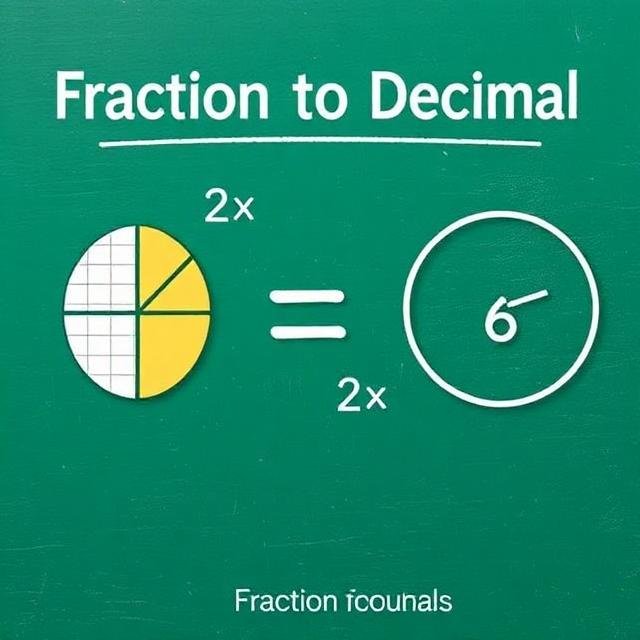
Table of Contents
ToggleConverting a fraction to a decimal is one of the most common skills in basic mathematics, and it becomes much easier once you understand the simple relationship between the numerator and denominator. A fraction represents a division problem, so converting a fraction into a decimal usually means dividing the numerator, which is the top number, by the denominator, which is the bottom number. For example, the fraction 1/2 means 1 divided by 2, and the answer is 0.5. Similarly, 3/4 means 3 divided by 4, which equals 0.75. Whether you are completing schoolwork, solving a practical measurement problem, comparing values, working with percentages, or using a calculator, knowing how to convert fractions to decimals is an important mathematical skill. In this complete guide, you will learn the easiest methods for converting a fraction to a decimal, understand the difference between terminating and repeating decimals, explore useful examples, and discover how calculators can make the process faster while still allowing you to understand the mathematics behind the answer.
What Does Fraction to Decimal Mean?
The phrase fraction to decimal refers to changing a number written in fraction form into an equivalent number written in decimal form. Fractions and decimals are two different ways of representing the same numerical value. For example, 1/2, 0.5, and 50% all represent the same amount. The fraction 1/4 is equal to 0.25, while 3/4 is equal to 0.75. The value does not change when you convert the fraction; only the way the number is written changes. Understanding this concept is important because different mathematical problems may require different number formats. Fractions are often useful when working with exact parts of a whole, while decimals are frequently easier to use in measurements, calculations, money, scientific work, and digital tools. When you know how to convert between these forms, you can work more comfortably with numbers and choose the format that best fits the problem you are solving.
The Basic Rule for Converting a Fraction to a Decimal
The simplest rule for converting a fraction to a decimal is to divide the numerator by the denominator. The numerator is the number on top of the fraction, and the denominator is the number on the bottom. The formula can be written as:
Numerator ÷ Denominator = Decimal
For example:
1/2 = 1 ÷ 2 = 0.5
Another example is:
3/5 = 3 ÷ 5 = 0.6
This method works for almost every fraction. If the numerator is smaller than the denominator, the answer will usually be less than 1. If the numerator is larger than the denominator, the answer will usually be greater than 1. For example, 7/2 means 7 divided by 2, which equals 3.5. The important thing to remember is that the fraction bar represents division. Once you recognize this, converting a fraction to a decimal becomes a straightforward division problem rather than a complicated mathematical process.
How to Convert a Fraction to a Decimal Step by Step
To convert a fraction to a decimal, begin by identifying the numerator and denominator. The numerator is the top number, and the denominator is the bottom number. Next, divide the numerator by the denominator using long division, a calculator, or mental math if the numbers are simple. For example, consider the fraction 5/8. The numerator is 5 and the denominator is 8, so you calculate 5 ÷ 8. Because 8 cannot go into 5 as a whole number, you add a decimal point and a zero, making 50. Eight goes into 50 six times, giving 48, with a remainder of 2. Continuing the division gives 0.625. Therefore, 5/8 = 0.625. This process can be repeated for any fraction, even when the decimal does not end. For instance, 1/3 becomes 0.333333…, which is a repeating decimal. The main idea remains the same: divide the numerator by the denominator until you reach the desired level of accuracy or identify the repeating pattern.
Converting Fractions with Denominators of 10, 100, or 1,000
Some fractions can be converted to decimals very quickly when their denominators are 10, 100, 1,000, or another power of 10. In these cases, the decimal point can be moved based on the number of zeros in the denominator. For example, 7/10 equals 0.7 because there is one zero in 10. The fraction 35/100 equals 0.35 because there are two zeros in 100. Similarly, 425/1,000 equals 0.425. This method is particularly useful because it does not require traditional division. You simply write the numerator as a decimal with the correct number of places. If the numerator does not have enough digits, you add zeros at the beginning. For example, 3/100 becomes 0.03, and 7/1,000 becomes 0.007. Learning this method can make fraction-to-decimal conversion much faster when you are working with measurements, percentages, money, or other values based on powers of ten.
Examples of Common Fraction to Decimal Conversions
Many common fractions have decimal equivalents that are useful to memorize. For example, 1/2 equals 0.5, 1/4 equals 0.25, 3/4 equals 0.75, 1/5 equals 0.2, and 4/5 equals 0.8. Other frequently used conversions include 1/10 = 0.1, 1/8 = 0.125, 3/8 = 0.375, 5/8 = 0.625, and 7/8 = 0.875. These values appear regularly in mathematics, measurements, construction, cooking, finance, and everyday calculations. Memorizing some of the most common fraction-to-decimal conversions can save time, but you do not need to memorize every possible fraction. If you forget an answer, simply return to the basic rule of dividing the numerator by the denominator. For example, if you do not remember the decimal equivalent of 7/16, you can calculate 7 ÷ 16, which equals 0.4375. The division method always provides a reliable way to find the correct answer.
Fraction to Decimal Examples Table
| Fraction | Division | Decimal |
|---|---|---|
| 1/2 | 1 ÷ 2 | 0.5 |
| 1/4 | 1 ÷ 4 | 0.25 |
| 3/4 | 3 ÷ 4 | 0.75 |
| 1/5 | 1 ÷ 5 | 0.2 |
| 2/5 | 2 ÷ 5 | 0.4 |
| 3/5 | 3 ÷ 5 | 0.6 |
| 4/5 | 4 ÷ 5 | 0.8 |
| 1/8 | 1 ÷ 8 | 0.125 |
| 3/8 | 3 ÷ 8 | 0.375 |
| 5/8 | 5 ÷ 8 | 0.625 |
| 7/8 | 7 ÷ 8 | 0.875 |
| 1/10 | 1 ÷ 10 | 0.1 |
This table demonstrates how different fractions can represent decimal values. It also shows that the denominator has a major influence on the resulting decimal. When the denominator is a factor of 10, 100, or 1,000, the decimal often ends neatly. When the denominator contains other prime factors, the result may continue indefinitely.
Terminating Decimals and Repeating Decimals
When converting a fraction to a decimal, the result can be either a terminating decimal or a repeating decimal. A terminating decimal ends after a specific number of digits. For example, 1/4 = 0.25 and 3/8 = 0.375. These decimals have a clear ending. A repeating decimal, on the other hand, continues forever with a repeating pattern. For example, 1/3 = 0.333333…, and 2/3 = 0.666666…. The repeating digit or sequence is often represented using a bar above the repeating numbers, such as 0.̅3 for one-third. Some fractions produce long repeating patterns, such as 1/7 = 0.142857142857…, where the sequence 142857 repeats. Understanding the difference between terminating and repeating decimals is important because not every fraction can be represented by a short decimal that ends. In some situations, you may need to round the answer to a certain number of decimal places.
How to Convert an Improper Fraction to a Decimal
An improper fraction is a fraction in which the numerator is greater than or equal to the denominator. Converting an improper fraction to a decimal uses exactly the same process as converting a proper fraction: divide the numerator by the denominator. For example, 9/4 means 9 ÷ 4, which equals 2.25. Therefore, 9/4 = 2.25. Another example is 11/5, which equals 11 ÷ 5 = 2.2. Improper fractions can also be converted by first changing them into mixed numbers, but direct division is usually faster. For example, 7/2 can be written as 3 1/2, and because 1/2 equals 0.5, the decimal answer is 3.5. Both methods produce the same result. The choice of method depends on whether you prefer direct division or working with the whole-number and fractional parts separately.
How to Convert a Mixed Number to a Decimal
A mixed number contains a whole number and a fraction, such as 2 1/4 or 5 3/8. To convert a mixed number to a decimal, first convert the fractional part into a decimal and then add the whole-number part. For example, 2 1/4 becomes 2 + 0.25, which equals 2.25. Similarly, 5 3/8 becomes 5 + 0.375, which equals 5.375. This method is simple because the whole-number portion stays the same while only the fractional portion needs to be converted. You can also convert the entire mixed number into an improper fraction first and then divide, but separating the whole number from the fraction is often easier for beginners. The most important thing is to keep the value of the number unchanged during the conversion.
Using a Calculator for Fraction to Decimal Conversion
A calculator can make fraction-to-decimal conversion extremely quick, especially when the numbers are large or the decimal result repeats. To use a basic calculator, enter the numerator, press the division button, and then enter the denominator. For example, to convert 13/16, calculate 13 ÷ 16, which gives 0.8125. Many scientific calculators and online fraction calculators can also accept a fraction directly and provide the decimal equivalent. However, it is still important to understand the underlying process rather than relying entirely on technology. Knowing that the fraction bar means division allows you to check whether a calculator answer makes sense. For example, if you are converting 3/4, you know the answer should be less than 1 and close to 1, so 0.75 is reasonable. This basic estimation skill can help you identify mistakes caused by entering numbers incorrectly.
Converting a Fraction to a Decimal Using Equivalent Fractions
Another useful method is to create an equivalent fraction with a denominator of 10, 100, or 1,000. This method works especially well when the denominator can easily be multiplied to reach a power of 10. For example, to convert 3/5 into a decimal, multiply both the numerator and denominator by 2. This creates 6/10, which equals 0.6. To convert 7/25, multiply both numbers by 4 to create 28/100, which equals 0.28. This method demonstrates an important rule of fractions: multiplying the numerator and denominator by the same nonzero number does not change the value of the fraction. Although this approach is not always possible with a simple multiplier, it is very useful for fractions whose denominators can be converted into 10, 100, or 1,000.
Common Mistakes When Converting Fractions to Decimals
One of the most common mistakes people make when converting a fraction to a decimal is dividing the denominator by the numerator instead of dividing the numerator by the denominator. For example, the correct conversion of 3/4 is 3 ÷ 4 = 0.75, not 4 ÷ 3. Another common mistake is placing the decimal point incorrectly when working with denominators such as 100 or 1,000. For example, 5/100 is 0.05, not 0.5. People also sometimes stop a repeating decimal without indicating that the answer continues, or they round too early and lose accuracy. To avoid these mistakes, always identify the top and bottom numbers before beginning the calculation, check whether the answer is logically reasonable, and use a repeating symbol or an ellipsis when a decimal continues indefinitely. Taking a few extra seconds to check your work can prevent many common errors.
Fraction to Decimal Conversion and Percentages
Converting fractions to decimals is closely connected to converting fractions into percentages. The first step is usually to convert the fraction into a decimal, and then multiply the decimal by 100 to find the percentage. For example, 3/4 becomes 0.75, and 0.75 × 100 = 75%, so 3/4 equals 75%. Similarly, 1/5 equals 0.2, and 0.2 × 100 = 20%. This relationship is useful in school mathematics, business, statistics, discounts, grades, and everyday comparisons. Understanding fraction-to-decimal conversion therefore gives you a foundation for working with percentages as well. The three forms—fraction, decimal, and percentage—can often be converted into one another, allowing you to choose the format that makes a particular problem easiest to understand.
Why Learning Fraction to Decimal Conversion Is Important
Learning how to convert a fraction to a decimal is useful far beyond the classroom. Decimals are commonly used in measurements, prices, percentages, statistics, computer programs, engineering, science, and financial calculations. A fraction such as 5/8 may be perfectly clear in a mathematical problem, but a decimal such as 0.625 may be easier to use in a calculator or measurement. Converting between these formats also helps you compare values more easily. For example, comparing 2/3 and 0.6 can be difficult if one value is written as a fraction and the other as a decimal. Converting 2/3 to approximately 0.667 makes the comparison much clearer. By understanding fraction-to-decimal conversion, you build a broader understanding of numerical relationships and become more comfortable solving different types of mathematical problems.
Conclusion
Converting a is fraction to decimal a simple mathematical process once you understand the basic rule: divide the numerator by the denominator. Fractions such as 1/2, 3/4, and 5/8 can be converted into decimals by performing the corresponding division, while fractions with denominators such as 10, 100, or 1,000 can often be converted quickly by placing the decimal point correctly. Some fractions produce terminating decimals, while others create repeating decimals that continue indefinitely. Whether you use long division, equivalent fractions, mental math, or a calculator, the goal is always to find an equivalent decimal value without changing the original number. With regular practice and an understanding of the different conversion methods, fraction-to-decimal problems become quick, predictable, and easy to solve.
Frequently Asked Questions About Fraction to Decimal
How do you convert a fraction to a decimal?
To convert a fraction to a decimal, divide the numerator by the denominator. For example, 3/4 means 3 ÷ 4, which equals 0.75.
What is 1/2 as a decimal?
The fraction 1/2 is equal to 0.5 because 1 divided by 2 equals 0.5.
What is 3/4 as a decimal?
The fraction 3/4 equals 0.75. You can find this by calculating 3 ÷ 4.
What is 1/3 as a decimal?
The fraction 1/3 equals 0.333333…, which is a repeating decimal. It can also be written as 0.̅3.
How do you convert an improper fraction to a decimal?
Divide the numerator by the denominator. For example, 9/4 becomes 9 ÷ 4 = 2.25.
Can every fraction be converted to a decimal?
Yes. Every fraction can be represented as a decimal, although some decimals terminate while others repeat forever.
What is the easiest way to convert a fraction to a decimal?
The easiest general method is to divide the numerator by the denominator using long division or a calculator.
How do you convert a fraction to a decimal without a calculator?
You can use long division or create an equivalent fraction with a denominator of 10, 100, or 1,000 when possible. For example, 3/5 can become 6/10, which equals 0.6.
Is a fraction the same as a decimal?
A fraction and a decimal can represent the same value, but they are different ways of writing that value. For example, 1/2 and 0.5 are equivalent.
How do you convert a decimal back into a fraction?
Write the decimal over a power of 10 and simplify. For example, 0.75 can be written as 75/100, which simplifies to 3/4.
What is 5/8 as a decimal?
5/8 equals 0.625 because 5 divided by 8 is 0.625.
What is the formula for fraction to decimal conversion?
The formula is:
Numerator ÷ Denominator = Decimal
For example: 7/10 = 7 ÷ 10 = 0.7.


Trending
 gaming3 months ago
UFC 5 Controls: Complete Beginner and Advanced Guide (PS5 & Xbox)
- Tech3 months ago
Aura Wallpaper: The Ultimate Guide to Beautiful Backgrounds for Every Device (2026)
- gaming3 months ago
r2rtrust.foullrop85j.08.47h Gaming: The Complete Guide for Every Gamer
- Entertainment3 months ago
Figure Skating Milano Cortina 2026: Complete Guide to the Olympic Competition
- NEWS2 months ago
Crypto Batter.com – Your Trusted Source for Cryptocurrency News, Market Trends, and Blockchain Insights
- Tech3 months ago
YouTube to MP3: The Complete Guide to Safe and High-Quality Audio Conversion
- Entertainment3 months ago
Flix HQ: Everything You Need to Know About the Popular Streaming Platform
- Tech3 months ago
Jack Swinney OneStaff Medical Email: How to Find the Right Contact Information